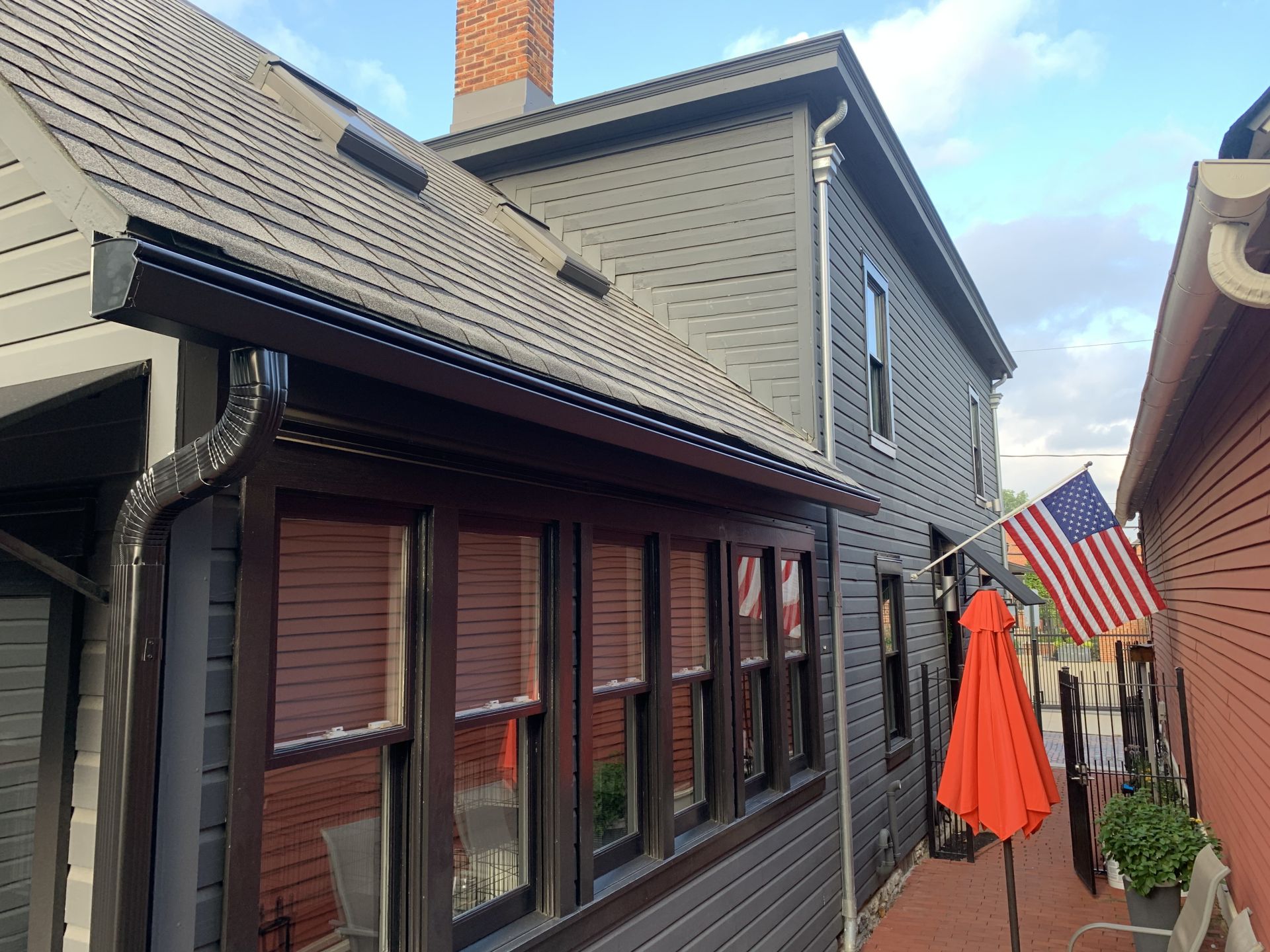
Note the distinct profile of this K-Guard gutter system. The telltale reverse curve of the system combined with a longer back makes the system instantly recognizable.
Noah: Take me back to the beginning. When was K-Guard founded, and what problem was it created to solve?
Justin: K-Guard was founded in 1996 in Colorado. The company moved to Columbus, Ohio in 2004 after a new general manager took over. Central Ohio is ideal logistically—shipping is efficient—and that leadership team had a strong numbers and auditing background, which helped professionalize the operation.
As for the product: K-Guard was influenced by what existed in the market, especially LeafGuard. LeafGuard is a one-piece system; K-Guard is a two-piece system, with two points of water entry—front and back. A major advantage is serviceability: with K-Guard, you can access the inside of the gutter system.
Another key difference is our business model. K-Guard is not a franchise. Dealers don’t pay royalties. We use a licensing structure: dealers purchase machinery from us and purchase key components (hangers, inside/outside miters, end caps). They can source their coil locally, which is a major advantage compared to models where coil must be purchased through a franchiser.
So, if LeafGuard introduced a strong concept, K-Guard addressed some of the pain points in a different company and structure. They are separate companies—but K-Guard was shaped by the gaps in what the market offered at the time.
Noah: Who was the original customer—homeowners or contractors?
Jordan: Both.
Justin: Residential and commercial. Anyone looking for a maintenance-free gutter solution. At the time, options were limited. LeafGuard was the main competitor, but it was an undersized gutter, which restricted commercial application.
K-Guard is essentially a hybrid system. It uses 6-inch gutter coil, so it has the capacity of a 6-inch gutter, but the top width is 5 inches—less surface area for debris to sit on. It’s also a high-back system: the back is about 6.5 inches tall, designed to handle volume and prevent water from getting behind the gutter. The back tucks under the drip edge to eliminate water intrusion behind the system. Because of its height, it can also function like a fascia wrap—reducing the need for additional wrapping in many situations.
Growth Cycles and Industry Context
Noah: Was there a moment when K-Guard realized the product could become something big?
Justin: K-Guard had a strong run in the mid-2000s through roughly 2015. Larger contractors were installing it. Over time, private equity and venture groups acquired some of those larger contractors, and that transition didn’t always help—those groups often weren’t rooted in the gutter or home improvement trades.
Then you had broader market cycles: the 2008–2009 housing downturn hit everyone, followed by another growth period. COVID was unusual—there was an initial slowdown, then a surge as homeowners invested in home improvement. K-Guard performed well in that rebound.
Another factor is dealer turnover. Some of our long-time dealers started in the early 2000s and are now retiring. Sometimes we get equipment sets back and look for new dealers. But demand remains steady—when a dealer exits, there’s usually someone right behind them ready to enter the program.
K-Guard's Position in the Market Today
Noah: How would you describe K-Guard's role in the industry today?
Jordan: We believe it’s the best maintenance-free product in terms of quality for the cost. A lot of products claim “maintenance-free” or offer a lifetime warranty but still require annual maintenance. K-Guard is different—we have customers who’ve had systems installed since the late 1990s without service.

A home with Black K-Guard Gutters
Ideal Dealer Profile and Why They Succeed
Noah: What kind of contractor tends to be the best fit—not just what they install, but their overall profile?
Jordan: Midsize roofing and exterior companies tend to be a great fit—often with sales teams around 10 and three to five crews. We see many of them start as roof-focused and then grow a significant K-Guard division. They have enough infrastructure to scale, and they’re willing to transition focus.
Very large organizations sometimes struggle to shift away from their existing “bread and butter.” Midsize operators can move faster and grow the category.
Justin: Margins are attractive, the product performs, and customers are satisfied—so contractors get fewer callbacks and stronger referrals. No system is truly infallible in every extreme scenario, but compared to flat screens and filters that create a shelf for debris, the reverse-curve design performs better. We often hear from homeowners who tried a more cost-effective option and then later upgrade to K-Guard.
Noah: Do roofers do well because they can scale faster than dedicated gutter companies?
Justin: It’s broader than roofers—exterior companies do well. Roofing is the top category, but siding and window companies also perform because once you’re already working on the exterior envelope, adding a premium gutter system is a natural extension.
Jordan: Dedicated gutter companies can do well too. We don’t require exclusivity—dealers can install standard open-top gutters and also offer K-Guard.
Dealer Network, Footprint, and Production
Noah: How big is K-Guard today—dealer footprint, scale, and reach?
Justin: We have dealers nationwide. Some have multiple locations, which can make the number look larger depending on how it’s counted. We have less footprint in California (we do have a dealer in the Sacramento area) and we’re still expanding into parts of the Mountain West.
Demand tends to be strongest where trees are common—primarily the Midwest, East Coast, and Southeast.
Jordan: The last major production record we published was over 30 million feet of gutter produced by our dealer network (around 2015).
Dealer Support: Technical, Customer, and Marketing
Noah: What infrastructure exists behind the scenes to support dealers?
Jordan: Dealers receive technical support for machine-related issues, customer support resources, and installation guidance. We also have in-house marketing support. When leads come to the home office, we route them to dealers at no cost.
We provide marketing materials dealers can customize—brochures, door hangers, digital assets, and video resources.
Justin: Being non-franchise is important. Dealers run their business as they see fit. We provide the system and support, but they control their operation.
Noah: What surprises dealers once they’re inside the system?
Jordan: From the business model perspective: what isn’t there—no royalties, no marketing fees, no forced franchise overhead. From the product side? How well it performs.
Justin: And while gutters aren’t typically considered “exciting,” K-Guard changes the look of a home. The profile can resemble crown molding, and paired with the 3x4 downspouts that are typically installed with the system, it creates a clean, upgraded appearance. Color contrast can dramatically increase curb appeal.
Jordan: Another point: K-Guard doesn’t interfere with the roof the way some products can, which matters for roof warranty considerations.
Product vs. Training - what drives results?
Noah: How much success comes from the product itself versus training and marketing?
Jordan: Many dealers report that a large portion of their sales—often 50% or more—comes from referrals specifically because of the product. We get frequent calls from homeowners who had K-Guard at a previous home and want it again.
Justin: When you can get the product in front of a homeowner and explain the differences, most choose K-Guard.
The Ramp: What a Dealer Looks Like After 2–3 Years
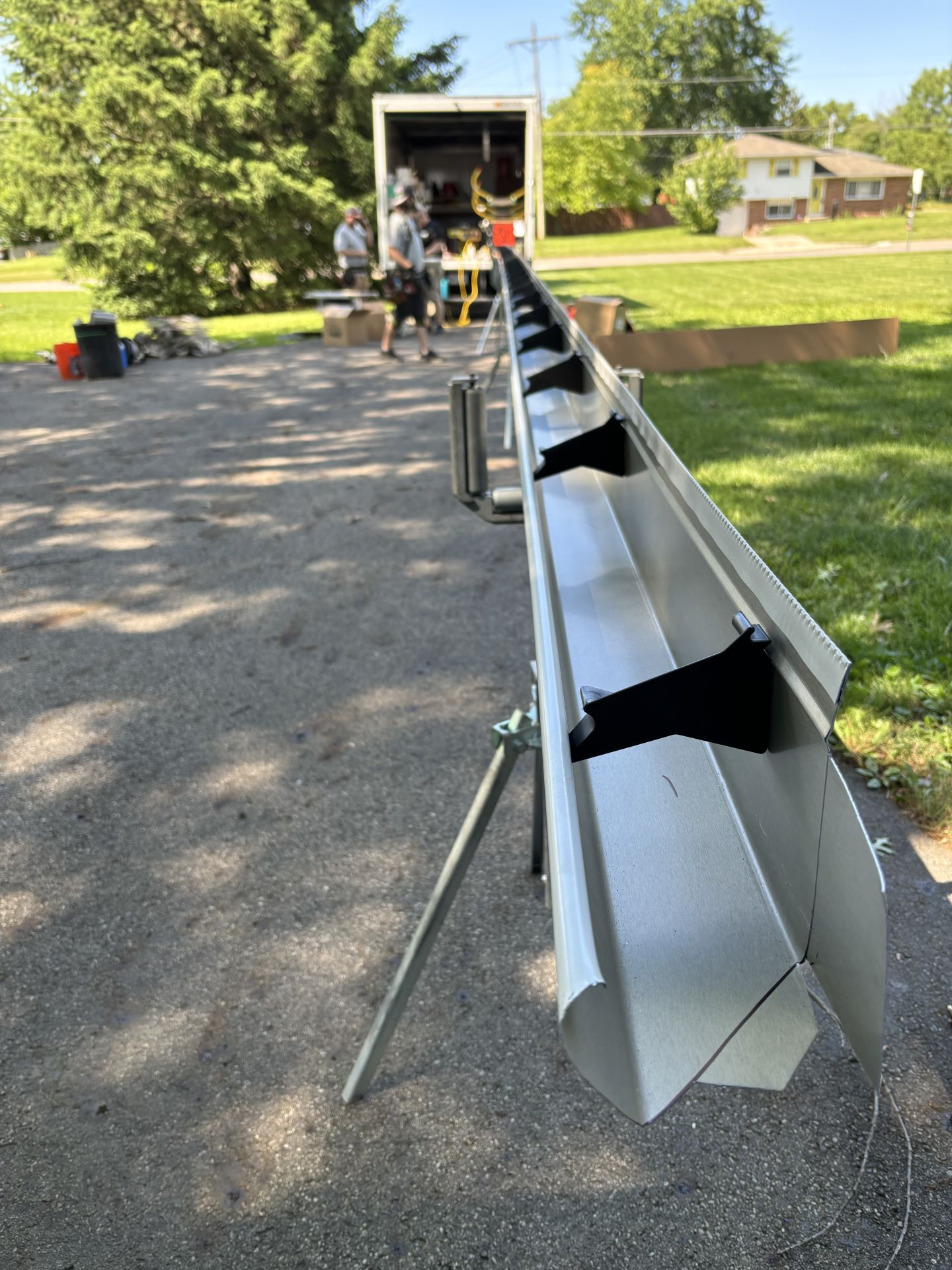
Prepping a run of K-Guard for install.
Noah: What does a dealer typically look like before joining and after a couple years?
Justin: It takes time. If a company has capital and invests heavily in advertising, it can ramp quickly, but for many dealers it’s a steady build. You’re not selling an add-on—you’re introducing a full gutter system, and that takes education.
Referrals create momentum. One installation often drives neighborhood demand.
Jordan: Company size matters. A small operator with one crew may take longer to scale. A midsize company with infrastructure may grow quickly. We’ve seen dealers expand from one crew to three within two years, and we’ve also seen companies produce 100,000 feet within six months when they have the structure and marketing in place.
Justin: On average, by year three, successful dealers are running strong.
Noah: What separates dealers who thrive from those who struggle?
Jordan: Lead flow and marketing execution. The best dealers typically have strong marketing teams. In today’s home improvement market, quality alone isn’t enough—you have to generate demand, communicate value, and install correctly.
Justin: SEO is especially important. Once a dealer’s website and search presence are established, lead volume improves dramatically. The bottom line is: if you can consistently generate leads, K-Guard is highly sellable when presented side-by-side with other options.
Culture and Values at K-Guard
Noah: From an employee perspective, what kind of people thrive at K-Guard?
Justin: We enjoy working with business owners and contractors, and we’re invested in their success—so long as they uphold the K-Guard brand.
Noah: How would you describe the culture?
Justin: Genuine. We’re straightforward, the product does what it claims, and we don’t overpromise.
Noah: What values guide how you work with contractors?
Justin: We do what we say we’re going to do—and we expect the same from our dealers.
Noah: What’s something most people don’t realize about the people behind K-Guard?
Jordan: We’ve installed the product and worked directly with customers. We understand what dealers experience day-to-day.
Justin: We’ve seen every facet of this business, and that’s why we can support dealers effectively. We’re not separated from the work—we’ve done it.
What's Next for the Gutter Industry and K-Guard
Noah: What’s changing in the gutter industry that contractors should watch?
Justin: Contractors need to be careful about what they install. The market is saturated with products that don’t perform as promised. If you install the wrong solution, you’ll live with callbacks and customer dissatisfaction.
Jordan: Installation quality varies widely—especially in new construction and storm-related work where speed and cost drive decisions. Homeowners are increasingly seeking vetted systems and trained installers. Contractors who prioritize quality and reputation will stand out.
Noah: How is K-Guard preparing for the next five years?
Justin: We’re focused on expanding the dealer network strategically without stacking territories. We’ve modernized our equipment—machines now use remote control features. The core product has not changed, and we believe it doesn’t need to.
Noah: What makes you personally proud to be part of the company?
Jordan: The product performs, it’s serviceable, it improves curb appeal, and it creates a finished look that homeowners notice. It transforms homes visually and functionally.
Justin: Everything is made and produced in the United States—machines, steel, metals. And we’re proud of the relationships with our dealers. Dealer trust is strong, and feedback from both dealers and homeowners is consistently positive.
Want to learn more about becoming a K-Guard dealer? Reach out to Justin at justin@kguard.com