
Christoper Dobrosky didn't set out to reinvent how gutters get sold: He set out to survive a pandemic. In the spring of 2020, freshly departed from a corporate sales management career and mid-pivot into his own window and sunroom company, he found himself staring at a government-mandated ban on in-home appointments and a business plan in ashes. What happened next became one of the more quietly radical experiments in the gutter industry's recent history.
Chris runs Gutter Genius out of Westmoreland County, Pennsylvania — a company approaching its first million dollars in annual revenue that has never, in any meaningful sense, gone out to measure a job before selling it. No site visits before the close, no tape measures pulled across fascia boards, no measure wheels, no in-person walkthroughs to count elbows. Just a phone call, Google Earth, an Apple Pencil, and a quote that lands in the customer's inbox just after their phone conversation ends.
"An overwhelming majority of our quotes go out within minutes of the phone call ending. I'm already looking at their house while we're talking."
How the Process Works
Most leads now come through his Gutter Genius website, where Chris directs prospects to fill out a quote request form. That flow gives him the information he needs before he even picks up the phone. The calls themselves average around eight minutes. By the end of that call, in most cases, the quote is already built.
"From beginning a phone call to hitting send is less than 30 minutes," he says. "By the time the phone call is done, I usually have the quote because everything's already templated in with Jobber. I get off the phone, go to Google Earth and do a quick measure, figure out how many downspouts they need, and add some numbers."
The measurement process relies almost entirely on Google Earth, with the occasional customer photo texted in. Out of nearly $850,000 in revenue last year, Gutter Genius paid for exactly 13 EagleView reports for jobs he couldn't get a reliable eye on remotely. Everything else is satellite imagery and a practiced eye. Chris sketches the gutter layout on a screenshot using an Apple Pencil and adds notations that give the quote a sense of thoroughness. Quantities are deliberately omitted.
"I think you muddy the water sometimes when you give the customer too much information," he explains. "We don't have quantities on anything — just line items."
The quote goes out with several attachments: cut sheets, a branded color chart marked with in-stock options, Alu-Rex warranty documentation, a note about financing, links to reviews, and two short product videos that Chris considers among his most effective sales tools.
The estimate itself is engineered for upselling. The base price is five-inch gutters and an upgrade to six-inch is presented as an obvious step up. Alu-Rex gutter guards are paired on over 85% of jobs, which pushes the average ticket from the $18–$22-per-foot range for gutters alone into the high $20s and low $30s per foot once the guard is included. They key with the way the quote is laid out is that customers don't feel pushed by salesperson — they instead feel like they're making smart choices.
The estimate itself is engineered for upselling. The base price is five-inch gutters and an upgrade to six-inch is presented as an obvious step up. Alu-Rex gutter guards are paired on over 85% of jobs, which pushes the average ticket from the $18–$22-per-foot range for gutters alone into the high $20s and low $30s per foot once the guard is included. They key with the way the quote is laid out is that customers don't feel pushed by salesperson — they instead feel like they're making smart choices.
Gutter Genius's Sales Stats
Speed as a Closing Strategy
On the Naysayers
Chris is well aware that the remote quoting model draws skepticism from many corners of the industry. The pushback, he says, tends to cluster around a few persistent concerns: How do you count elbows? How do you know what the fascia looks like? How do you pick a color without a sample in hand? Where will the downspouts go?
His answers are pragmatic. On parts: every job gets loaded with everything from the relevant shelf colorwise (boxes of elbows, miters, etc), regardless of what his remote measurement and takeoff indicated. Nothing is staged precisely.
"Why would you not have extra?" he asks. "Things go wrong." On fascia: he passes on the jobs — older homes with unusual construction — that genuinely require in-person assessment, referring them to another contractor. On color: the branded color chart in the email covers it, and the phone call does the rest.
"Why would you not have extra?" he asks. "Things go wrong." On fascia: he passes on the jobs — older homes with unusual construction — that genuinely require in-person assessment, referring them to another contractor. On color: the branded color chart in the email covers it, and the phone call does the rest.
"I am generally part of the color conversation on the phone. A lot of what we're doing is trying to get them excited about a color change — updating the look of the house to something more contemporary — rather than less excited about paying money to put a new aluminum trough on their house."
For the rare homeowner who genuinely needs to see the product, Chris will mail a sample. For the even rarer homeowner who wants someone to stand in their driveway before they sign, he offers an in-person walk-around at the close of every call — and notes that almost nobody ever takes him up on it.
He does acknowledge one genuine limitation. "I would sell a ton more. I'd convert more and at higher job sizes if I were in person," he says plainly. "But I'm 52. I've run way more than 10,000 appointments in my life, and I don't want to do that every day anymore."
He also notes one deliberate adjustment he's made: for homes valued at $750,000 or above, he proactively offers an in-person visit at the start of the conversation. His experience at Renewal taught him that high-net-worth buyers — driver personalities, senior executives, decision-makers by trade — often respond poorly to a process that doesn't give them choices. "Those people are used to making decisions. Trying to strong-arm them is not always a good way to close."
What Makes Gutter Genius's Close Rate 58%
A 58% close rate is not an accident. It is the product of several compounding advantages that Chris has deliberately assembled over five years in the business.
Reviews are foundational. Gutter Genius has accumulated over 300 reviews across Google and Angie's List, making it among the best-reviewed gutter contractors in the Pittsburgh market. Chris works this into every phone call — not as a boast, but as a punchline. "So why'd you call us?" He asks - then offers " '...Was it because you saw that this local company has an absolutely incredible number of five-star reviews?' It's just to remind them that's exactly why they called."
Content has become an increasingly powerful driver. About eighteen months ago, Chris started producing video reels using a DJI Osmo Pocket 3, passing the footage to a full-time virtual assistant who edits and publishes it. The content — job walkthroughs, color conversations, problem-solution narratives — now generate hundreds of thousands of views per month in the Pittsburgh area. Customers call knowing who they're dealing with.
"It builds confidence. People feel like they know you. We get calls where I know they're calling because they've seen our content. We sold a big job recently and the guy said he'd been watching our reels on Instagram — he was on there looking at vintage dirt bikes and kept seeing our videos."
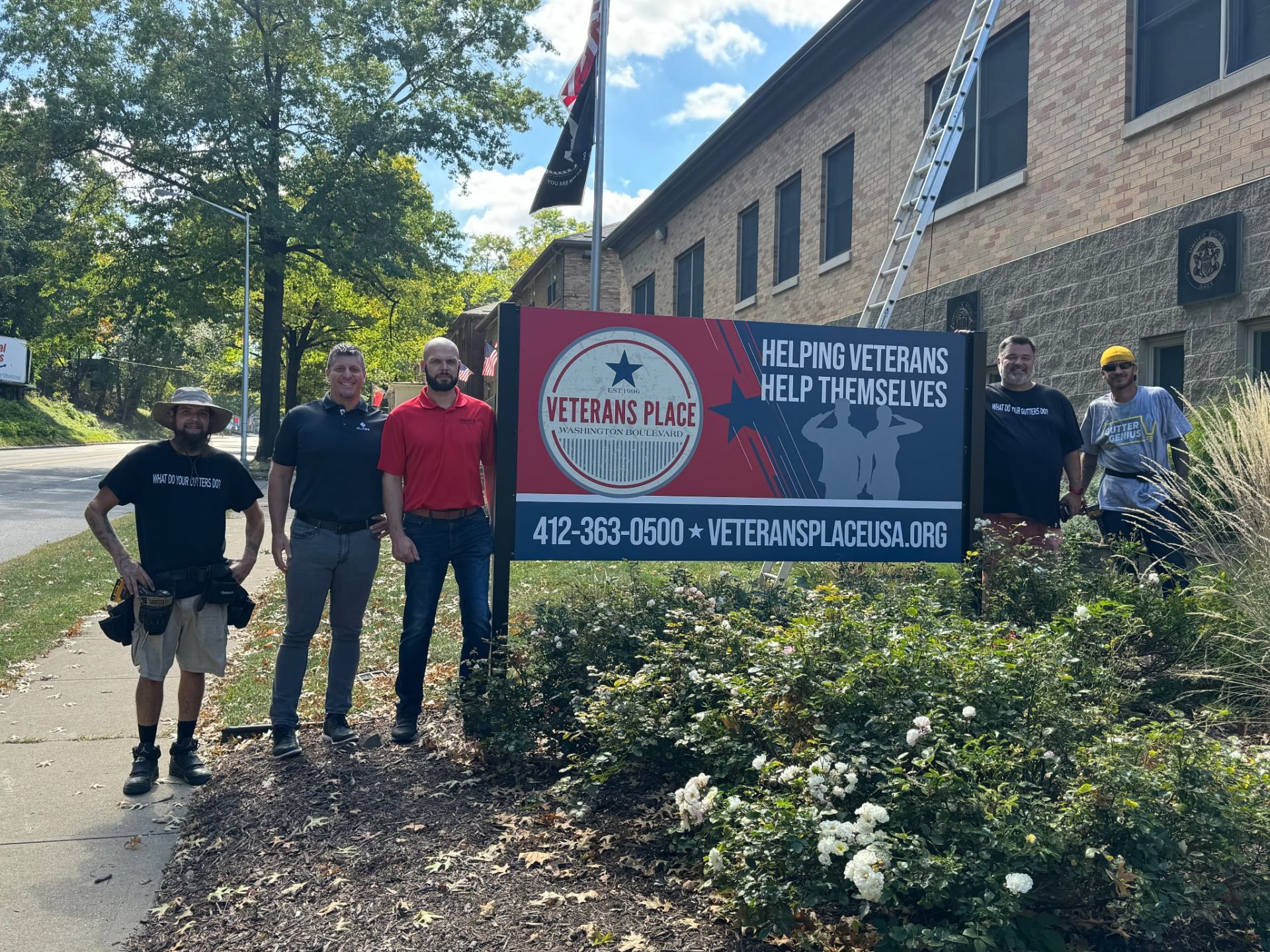
There is also the charity component. Every Gutter Genius quote includes a pre-selected $25 donation to Veterans Place of Washington Boulevard, a Pittsburgh-based organization that helps homeless veterans. Gutter Genius matches every contribution. The line item is removable — but opt-out, not opt-in. Penetration sits above 90%.
What Makes it Possible
Perhaps the most striking aspect of the Gutter Genius model isn't the close rate or the revenue — it's what the model enables beyond the business itself. Chris describes a working life that is, by any conventional standard in the trades, unusual: no commuting to job sites, no standing in driveways in the rain, no scheduling matrix of in-person appointments. A laptop, a phone, and Jobber are the tools of the trade. He takes four vacations a year.
"I work more now than I ever did, but I'm never unhappy," he says. "At my old job I was always just redlined with stress. Now, if people don't buy, I don't care."
He is not naïve about the model's vulnerabilities. Everything runs through him. His install teams — all W2 employees, the newest with three years of tenure — are a single point of fragility. "If I lost my team it would be very hard to replace. That's where I'm playing with fire."
He is also beginning to explore what happens when he steps back further, testing AI-powered receptionist tools and leaning on his VA to handle inbound calls during vacations.
He is also beginning to explore what happens when he steps back further, testing AI-powered receptionist tools and leaning on his VA to handle inbound calls during vacations.
The longer-term plan is horizontal rather than vertical: more services (gutter cleaning, dryer vent cleaning, window cleaning, seasonal lighting) marketed back to an existing customer base, plus potentially a partner in another market who could run a virtual Gutter Genius location using the same satellite-quote playbook.
For contractors weighing whether remote selling could work in their own markets, Chris's advice is characteristically direct: start with the jobs you would have declined anyway. The ones too far out, the ones you're slow to follow up on, the ones where the drive isn't worth the ticket. Measure them on satellite. Send a quote. See what happens.
For contractors weighing whether remote selling could work in their own markets, Chris's advice is characteristically direct: start with the jobs you would have declined anyway. The ones too far out, the ones you're slow to follow up on, the ones where the drive isn't worth the ticket. Measure them on satellite. Send a quote. See what happens.
"I think there's opportunity for everyone to try this — especially for the jobs that are a little farther out than you want to drive. Try it. It's not complicated."
Need Gutters? Reach out to Chris By Clicking the Logo Below

DESIGN. PROTECT. ENHANCE. SEAMLESSLY.
Copyright © 2026
Created with